A 10% thickness variance across a single roll is enough to cause adhesion failure at the edges — yet fewer than half of first-time buyers request a caliper-measured datasheet before approving production.
For buyers in the United States sourcing self adhesive vinyl at volume, the difference between a successful project and a costly reprint almost always traces back to five or six spec fields that were never confirmed before the order shipped.
This guide covers exactly those fields — measurable, supplier-verifiable, and directly tied to real-world performance on press, on plotter, and on the installation surface.
The numbers that matter
| Specification | Typical range to confirm |
|---|---|
| Film thickness | 2–4 mil (50–100 µm) cast; 3–5 mil (75–130 µm) calendered |
| Dimensional stability (shrinkage) | ≤0.3% after 24 h at 70 °C per ASTM D1204 |
| Initial tack (loop tack) | 300–700 g/25 mm depending on substrate |
| Peel adhesion (180°) | ≥600 g/25 mm on stainless steel after 24 h dwell |
| UV resistance stated lifespan | 3–7 years outdoor (verify test standard, not marketing copy) |
| Operating temperature range | −20 °F to +180 °F for most permanent adhesive films |
| Release liner basis weight | 78–140 gsm silicone-coated paper or PET film |
| Roll width tolerance | ±0.5% of stated width |
Every number in this table should appear on a supplier’s product datasheet. If it doesn’t, that absence is itself a decision signal.
Film Thickness and Dimensional Stability
Film thickness requirements
Film thickness is the single spec that controls everything downstream: ink laydown, cutting force calibration, and the tactile quality buyers associate with premium graphics. For many general-purpose calendered graphic films, thickness around 3–4 mil is common, while cast films are often thinner and selected for greater conformability.
Cast vinyl films typically run 2–3 mil and offer the best conformability over rivets and corrugated surfaces. Calendered films run 3–5 mil and are generally more cost-effective for flat-surface applications. The mistake is treating all film constructions as interchangeable on price alone — an economy monomeric calendered film used on demanding compound curves may be more prone to shrinkage or edge lift than a suitable polymeric or cast film.
Confirm thickness using ASTM D374 or ISO 4593. A datasheet listing only nominal thickness with no tolerance band is a yellow flag; ±0.2 mil is a reasonable manufacturing tolerance to expect stated in writing.
You can cross-reference our PVC flex banner buying guide for comparison points on roll specifications, print compatibility, and purchasing tolerances across large-format PVC print media.
Dimensional stability and shrinkage tolerance
Shrinkage is the spec buyers most often skip — and the one that causes the most visible failures in printed graphics. Vinyl film expands and contracts with temperature and humidity; unchecked, that movement registers as banding, misregistration, or lifted seams.
The industry standard test is ASTM D1204: a sample is conditioned at 70 °C for 24 hours and shrinkage is measured in both machine and cross-machine direction. Acceptable performance for outdoor graphics is ≤0.3% in either axis. Films rated above 0.5% should not be specified for precision multi-panel installations.
Cast films consistently outperform calendered films on this dimension — a genuine technical difference, not a branding claim. For large-format wall graphics or vehicle wraps where panel-to-panel registration matters, dimensional stability should rank above cost per roll in your evaluation criteria.
The rule: Always request dimensional stability data in both MD and CMD directions. A single-direction figure is incomplete and may obscure a cross-grain shrinkage problem.

Adhesive Performance and Surface Compatibility
Initial tack and peel adhesion
Adhesive performance breaks into two distinct measurements that serve different purposes. Initial tack (measured as loop tack, typically 300–700 g/25 mm) tells you how well the film grabs on first contact — critical for production-speed lamination or hand-application without air bubbles. Peel adhesion at 180° after 24-hour dwell tells you long-term bond strength under real-use conditions.
For permanent adhesive applications — outdoor signage, window graphics rated for multi-year lifespan — a minimum 180° peel of 600 g/25 mm on stainless steel is a reasonable floor. Removable adhesive films run lower, typically 200–400 g/25 mm, and are specifically engineered to release cleanly from painted surfaces.
The dwell condition matters. A 30-minute peel value should not be compared directly with a 24-hour or 72-hour result, so buyers should confirm the dwell time used for every quoted adhesion value.
Substrate and installation-surface requirements
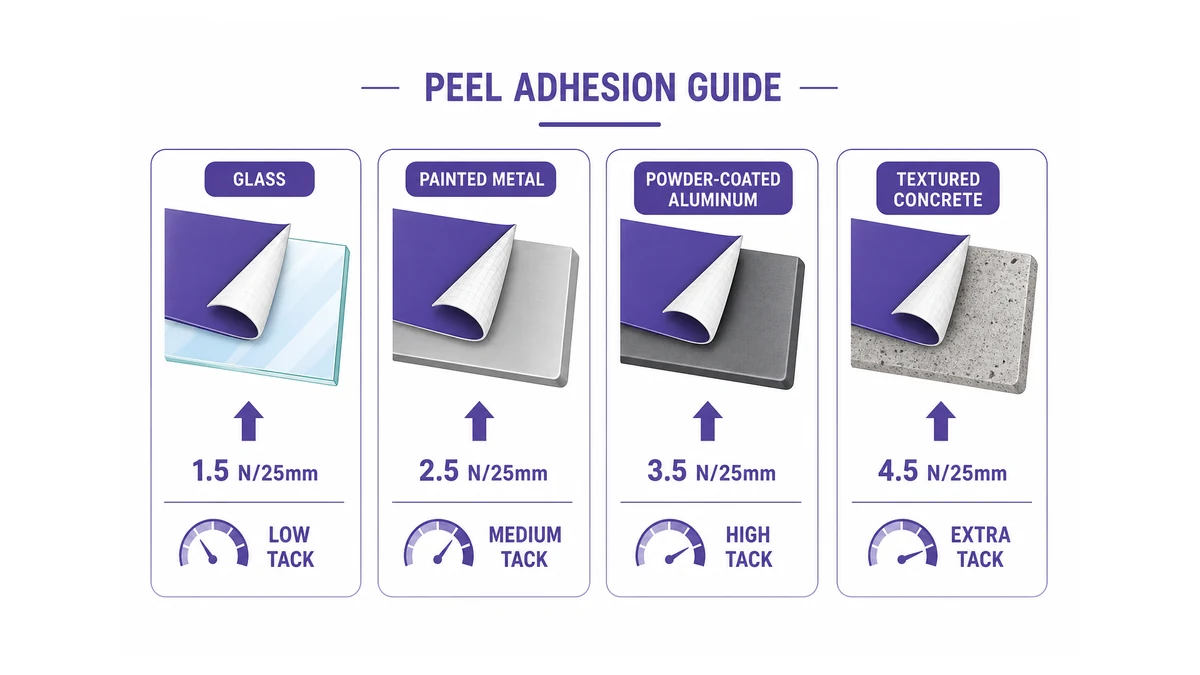
Adhesive performance is not a fixed number — it varies with surface energy, texture, and contamination. High-surface-energy substrates (glass, metal, rigid PVC) support strong adhesion; low-surface-energy materials (polyethylene, polypropylene, powder-coated finishes) require a high-tack or primer-recommended adhesive.
Surface roughness is the overlooked variable. A film with acceptable peel on flat glass may show 30–40% lower adhesion on painted concrete block. If your application involves textured surfaces, ask the supplier for adhesion test data on a comparable substrate — not just the standard stainless-steel reference panel.
For reference on how substrate compatibility translates to installation specifications, see our Self Adhesive Vinyl Clear Glossy.
Print Compatibility and Surface Finish
Ink and printer compatibility
Specify ink system before specifying vinyl. Solvent, eco-solvent, UV-curable, and latex inks each interact differently with vinyl topcoats — and an adhesive vinyl film optimized for eco-solvent will produce washed-out color under UV-curable inks with no ink-adhesion treatment.
The supplier’s datasheet should list compatible ink chemistries explicitly. If it lists only “solvent compatible” without distinguishing eco-solvent from aggressive solvent, request clarification — the coating formulations are different and performance gaps are real. Films intended for latex printing require a porous topcoat that allows off-gassing during the cure cycle; standard cast films don’t always provide this.
The mistake to avoid: Approving a vinyl film on print quality from a trade-show proof, then discovering the production print run used a different ink system. Confirm ink chemistry, RIP profile, and pass count with your print provider before final film selection.
Gloss, matte, and satin finish requirements
Surface finish affects both final appearance and durability. Gloss films offer higher color vibrancy and are easier to clean, but show fingerprints and micro-scratches more readily. Matte films reduce glare in high-ambient-light environments and read better at shallow viewing angles.
The specification to confirm is 60° gloss reading (per ASTM D523): gloss films typically run 80–100 GU, satin 30–60 GU, and matte below 20 GU. A supplier describing a film as “semi-gloss” without a measured value is not giving you a spec — it’s giving you a marketing description. Get the number.
Satin and matte finishes also tend to show more adhesion variance in humid conditions because the topcoat is more porous. For outdoor applications with high moisture exposure, gloss or overlaminated matte are typically the more durable choices.
Outdoor and Environmental Performance
Temperature and weather-resistance range
Adhesive vinyl used in outdoor applications in the United States must perform across a temperature range that most buyers underestimate. In northern states, film may see −20 °F in winter; in southern states, surface temperatures on south-facing metal signs can exceed +180 °F in summer.
Confirm both the application temperature floor and the service temperature ceiling. Application temperature is usually 50–90 °F for standard permanent adhesive films; applying below this threshold produces incomplete adhesive wetting and early edge-lift. Service temperature is a separate, higher figure — but both must appear on the datasheet.
Moisture resistance is equally important. Films used in high-humidity environments (coastal United States, greenhouse or car-wash applications) should specify hydrolysis resistance and carry test data on adhesion retention after 500-hour humidity exposure per ASTM D1037 or equivalent.
UV resistance and stated outdoor durability
“3–5 year outdoor durability” appears on a significant number of vinyl datasheets — and the number is nearly useless without knowing the test method behind it. The difference between a film tested to ASTM G154[1] accelerated UV weathering and one rated by the supplier’s own field observation is substantial.
Ask for the specific test standard, the test duration, and what pass/fail criterion was applied. A film rated at 3 years outdoor using 500 hours of G154 UV exposure at 340 nm is a documented specification. A film rated at 5 years because “field installations have held up” is an observation, not a specification.
For United States outdoor graphics, films intended for permanent application should carry a minimum of 3-year UV resistance[1] certification from an independent laboratory. Seven-year films do exist — cast vinyl with UV-stabilized topcoats and AAMA 2605[2] equivalent testing — but the cost premium is meaningful and only justified for long-cycle installations.
Release Liner and Converting Requirements
Liner weight and release performance
The release liner is the most underspecified component in adhesive vinyl procurement. Liner failures — tearing during unwind, adhesive transfer to the back of the liner, or inconsistent release force — waste production time and can contaminate large press runs.
Liner basis weight should be confirmed, not assumed. Standard paper liners run 78–90 gsm; heavier 120–140 gsm paper liners offer better dimensional stability for precision cutting applications. PET film liners (typically 50–75 µm) are preferred for high-speed digital cutting because they maintain flatness better than paper under low-humidity conditions common in air-conditioned production facilities.
Release force — the peel force needed to separate the liner from the adhesive — should be 10–30 cN/25 mm for most applications. Below 10 cN, the liner may separate prematurely on the roll; above 30 cN, manual application becomes difficult and stretch marks can develop in the adhesive layer.
The exception: For robotically applied vinyl (automated label application or plotter-cut graphics with automated weeding), a tighter release force window — typically 15–25 cN/25 mm — should be specified to maintain consistent machine cycle times.
Cutting, weeding, and dimensional tolerance
Plotter cutting performance depends on a combination of film hardness, adhesive tack, and liner thickness. The most common cutting failure is adhesive stringing — where the adhesive layer stretches rather than shearing cleanly at the blade tip. This is a function of adhesive formulation and temperature, not blade sharpness alone.
For vinyl cut on an electrostatic cutting table, confirm that the film has an antistatic treatment or conductive backing — standard cast vinyl can develop enough static charge on the cutting table to shift the material mid-cut, producing registration errors of 1–2 mm on long runs.
Dimensional tolerance for cut graphics should be confirmed at ±0.5 mm over a 24-inch span. Any supplier offering tighter tolerances on calendered film in a production environment should be asked how they validate that claim.
Roll Size and Order Tolerances
Roll width, roll length, and tolerance
Roll width and roll length tolerances vary by manufacturer and product specification. Buyers should confirm the nominal roll dimensions and permitted tolerance directly in the supplier’s TDS, quotation, or purchase specification. For high-volume orders, even a small permitted shortfall can materially affect usable delivered length.
Packaging, joints, and usable roll length
Splices (mid-roll joints) are legal in most adhesive vinyl categories but must be disclosed. A reputable supplier will specify maximum joint count per roll (usually ≤2 for rolls under 100 yards) and minimum segment length between joints (usually ≥5 yards). Joints that fall without adequate leader length force waste at the beginning of a print run or create press registration problems.
Confirm core diameter (3-inch vs. 1.5-inch) and maximum roll outer diameter against your unwind equipment before ordering. A mismatch here is an avoidable operational disruption that shows up on the first delivery.
Sample Approval Before a Bulk Order
Print and color compatibility
A sample approval process should not be a formality. Print a full-scale proof on the production film, using your production ink system, RIP profile, and printer, before releasing a bulk order. Color gamut, ink adhesion, and dry time all vary between film lots — and a lab-printed approval sample from the supplier’s facility does not replicate your production conditions.
Specifically, check color accuracy against a calibrated reference (Delta E ≤2 is the standard for color-critical work per ICC color management guidelines[3]), and check ink adhesion with a cross-hatch tape test per ASTM D3359[4].
Adhesion and application performance
On the adhesive side, the sample test should replicate real installation conditions. Apply to the actual substrate used in production, at the actual ambient temperature of the installation environment, and evaluate peel adhesion at both 24 hours and 72 hours.
Adhesive-related failures that don’t appear until 48–72 hours post-application represent the most expensive category of field failure — by that point, the graphics are installed and replacement requires both materials and labor. A 72-hour sample evaluation adds two days to your approval timeline and eliminates this failure mode entirely.
Self Adhesive Vinyl Specification Checklist
Technical specifications to confirm
Before placing any bulk order, confirm the following from the supplier’s datasheet:
- Film thickness (nominal + tolerance, measured by ASTM D374 or ISO 4593)
- Dimensional stability / shrinkage (MD and CMD, per ASTM D1204, ≤0.3%)
- Initial tack (loop tack, g/25 mm)
- Peel adhesion (180°, 24-hour dwell, g/25 mm on stainless steel)
- Application temperature range (floor and ceiling in °F)
- Service temperature range (floor and ceiling in °F)
- UV resistance rating (years + test standard + test duration)
- 60° gloss reading (per ASTM D523, in GU)
- Compatible ink systems (solvent, eco-solvent, UV, latex — specify which)
- Release liner basis weight (gsm) and release force (cN/25 mm)
- Roll width tolerance (±% of stated width)
- Roll length tolerance (±% of stated length) and maximum joints per roll
Required supplier datasheet information
A complete supplier datasheet for adhesive vinyl should include — at minimum — the test method cited alongside each performance value, the ink system(s) tested for print compatibility, and the specific substrate used for adhesion measurements. If a datasheet lists performance values without citing test methods, treat those values as unverified claims.
Ask your supplier explicitly for the following documents before approving production:
- Product technical data sheet (TDS) with all test methods cited
- Material Safety Data Sheet (SDS/MSDS) for compliance with OSHA HazCom standards[5]
- Third-party UV weathering test report (if outdoor durability is claimed)
- Certificate of conformance to ISO 9001 or equivalent quality management standard
At KUNMAO, our datasheets are generated from 3-stage QC data — raw material, in-process, and final inspection — so every value on the sheet traces to a documented measurement, not a catalog estimate. That traceability is the difference between a spec you can rely on and one you’re hoping holds up. Buyers sourcing at scale should demand the same standard from any supplier they evaluate.
Have a project or a spec sheet in hand? Talk to kunmao2026-com — real engineers answer.
Frequently Asked Questions
Should I choose permanent or removable adhesive for printed self adhesive vinyl?
Choose permanent adhesive when the graphic needs stronger, longer-term bonding, such as signage or long-term promotional graphics. Removable adhesive is better for temporary campaigns, short-term displays, or applications where clean removal is important. Always test the adhesive on the actual substrate because removal performance can vary with surface type, temperature, and installation time.
What is the difference between monomeric, polymeric and cast self adhesive vinyl?
Monomeric vinyl is generally suited to economical short-term graphics on flat surfaces. Polymeric vinyl offers better dimensional stability for more demanding outdoor and slightly curved applications. Cast vinyl provides the highest conformability and is typically selected for complex curves, recesses, and demanding vehicle graphics. Buyers should match the film construction to the application rather than comparing thickness alone.
Is grey adhesive self adhesive vinyl fully blockout?
Not necessarily. Grey adhesive improves hiding power and reduces show-through from dark substrates, old graphics, or coloured panels, but it does not automatically make the material fully blockout. If opacity is critical, ask the supplier for measured opacity data or a blockout test for the exact film-and-adhesive construction.
How long should eco-solvent printed self adhesive vinyl outgas before lamination?
Allow solvent or eco-solvent printed vinyl to outgas for at least 24 hours before lamination. Longer drying time may be required for heavy ink coverage or certain production conditions. Laminating too early can trap residual solvent, which may affect the adhesive and contribute to bubbling, lifting, or delamination.
Sources
[1] ASTM G154 UV Weathering Testing Services — micomlab.com
[2] AAMA 2605-05 – Voluntary Specification, Performance … — starrail.com
[3] International Color Consortium — color.org
[4] Standard Test Methods for Rating Adhesion by Tape Test — store.astm.org
[5] 1910.1200 – Hazard Communication. — osha.gov